Road rules, licensing, and vehicle regulations vary by country and state – always verify the requirements that apply where you drive before relying on this guidance.
Total brake failure is rare in modern cars, but knowing what to do turns a terrifying moment into a manageable one. The response is a sequence of calm actions, not panic, and most of it relies on slowing the car by means other than the failed brake pedal.
Stay calm and don’t panic-steer
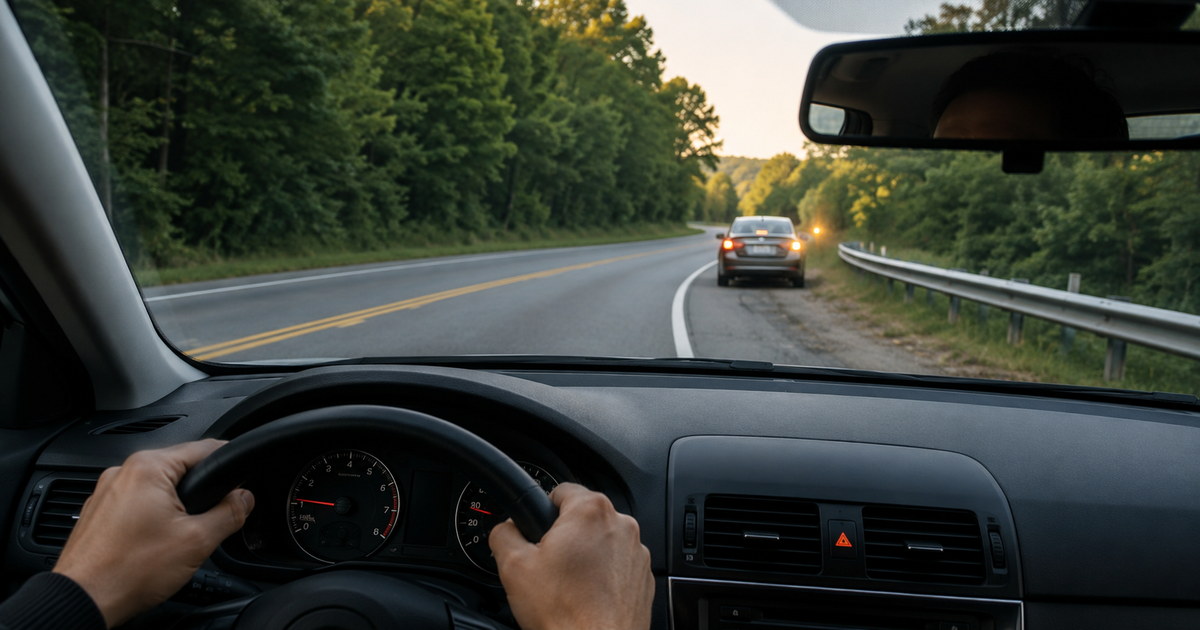
The first job is to keep control of the car and avoid a violent swerve. Keep both hands on the wheel, look where you want to go, and warn others by sounding the horn and switching on hazard lights so traffic around you gives space. Panic causes more harm than the failure itself, so a steady head while you work through the steps below is the most important thing.
Pump the brake pedal
Modern cars have dual brake circuits, so a complete loss is unusual; often some braking remains. Pump the brake pedal firmly and repeatedly, which can build up pressure in a system that has partially failed and may restore some stopping power. If you have older non-ABS brakes, pumping can also recover pressure. Do this while beginning the other steps rather than relying on it alone.
Shift down to slow the car
Use engine braking to bleed off speed: ease off the accelerator and shift to progressively lower gears, in an automatic by selecting a lower range, in a manual by changing down through the gears. This makes the engine hold the car back without the brakes. Do not slam straight into the lowest gear at high speed, but step down so the engine slows you steadily, which can shed a lot of speed on its own.
Use the parking brake gradually
The parking or emergency brake operates separately from the main system and can help slow the car, but it must be applied gradually, not yanked, since a sudden full application can lock the rear wheels and cause a skid. Pull or press it slowly and progressively, ready to ease off if the back of the car steps out. Combined with engine braking, it can bring the car down to a stop.
Steer toward a safe place to stop
As you lose speed, steer toward somewhere safe to come to rest: a clear shoulder, an uphill stretch that will help slow you, or an open area away from traffic and obstacles. Avoid the temptation to aim for an exit you must brake hard for. If you are on a long descent and cannot slow enough, look for a runaway escape ramp where one exists. The goal is to use the road and terrain to help you stop.
Rubbing off speed as a last resort
If the car still will not stop and a collision is imminent, slowing by gently grazing a guardrail, kerb or roadside vegetation with the side of the car is far better than a high-speed impact, and protecting yourself and others is the priority over the vehicle. These are last-ditch measures, but knowing they exist helps you act decisively rather than freeze. Once stopped, do not drive on; call for assistance and have the car recovered.
Prevention: don’t get here
Brake failure is usually preventable through maintenance, since brakes give warning signs, squealing, a soft or sinking pedal, a brake warning light, or fluid leaks, long before they fail completely. Heeding these and keeping up with inspections, as in our brake inspection checklist, means you almost never face a real failure. Treat any change in how your brakes feel as a prompt to get them checked promptly, much as our general driving safety guidance stresses for other warning signs.
Brake-failure checklist
If your brakes fail:
- Stay calm, hold the wheel, use horn and hazards.
- Pump the brake pedal firmly to try to restore pressure.
- Shift down to slow the car with engine braking.
- Apply the parking brake gradually, never all at once.
- Steer to a safe place; use terrain or, as a last resort, friction to stop.
After you stop, don’t drive on
Once you have brought the car safely to rest, the trip is over until the brakes are fixed; do not try to limp on, even if some braking seems to have returned, because a partially failed system can fail completely at any moment. Switch on hazard lights, get yourself and any passengers to a safe place away from traffic, and call for assistance to have the car recovered. Note what happened, a sinking pedal, a leak, a warning light, since it helps diagnosis. Brake failure almost always traces back to neglected maintenance or ignored warning signs, so the lasting fix is prevention through the checks in our brake inspection checklist. Treat a real brake failure as a clear signal that the braking system needs professional attention before the car is driven again, rather than something to nurse home.
Sources
This is general emergency guidance. Regular brake maintenance is the real safeguard; have any change in brake feel inspected promptly by a professional.