Reviewed for safety and technical accuracy by an Auto Drive Tips subject-matter contributor. Road rules, licensing, and vehicle regulations vary by country and state — always verify the requirements that apply where you drive before relying on this guidance.
An improperly coupled trailer is one of the most dangerous mistakes a truck driver can make, because a trailer that separates from the tractor is catastrophic. Coupling and uncoupling follow a careful sequence, and the discipline of checking each step, every time, is what prevents disaster.
Why the sequence matters
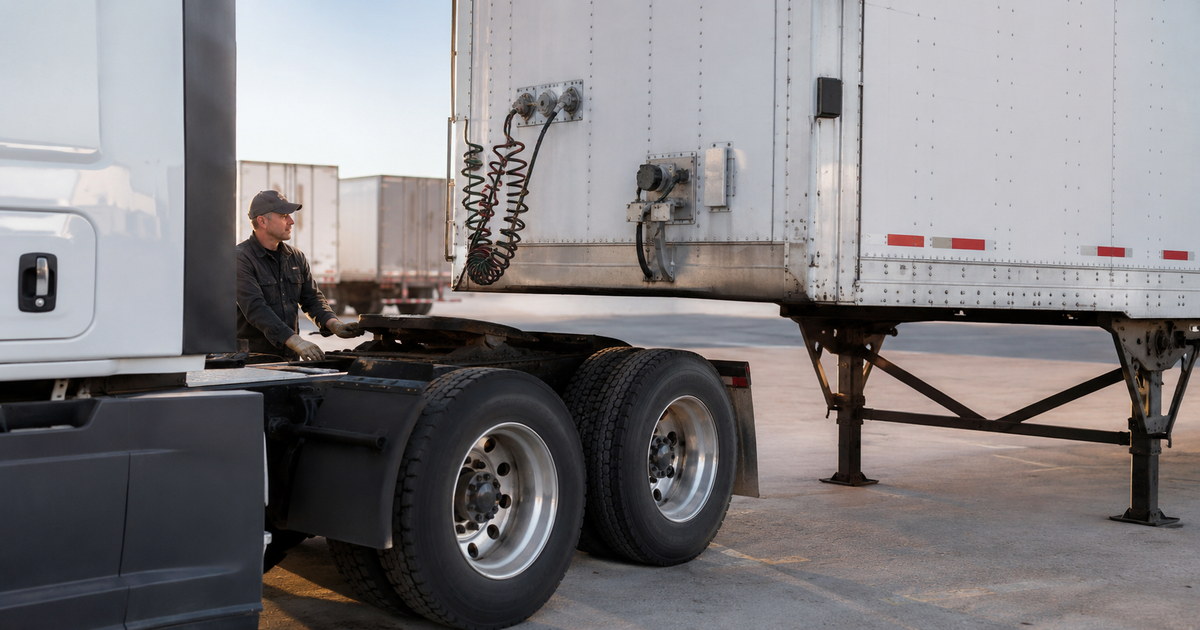
Coupling joins a heavy trailer to the tractor through the fifth wheel and kingpin, and connects the air and electrical lines that control brakes and lights. If any part is wrong, an unlocked fifth wheel, a misaligned kingpin, a disconnected air line, the consequences range from lost brakes to a dropped trailer. That is why professional training treats coupling as a strict, verified routine rather than a casual hook-up.
Line up and back under
Position the tractor squarely in front of the trailer and at the correct height, with the fifth wheel low enough to slide under and tilted to receive the kingpin. Back slowly and straight so the kingpin enters the centre of the fifth wheel; getting the alignment and height right before backing prevents damage and a bad couple. Reverse gently, the same low-speed care covered in our truck driver safety guide.
Lock the fifth wheel and check it
Back until the fifth wheel locks around the kingpin, then confirm the lock visually: the locking jaws should be closed around the kingpin and the release handle in the locked position, with no gap between the trailer and the fifth wheel plate. This visual inspection, getting down and looking, is essential, because a couple that feels right can still be unlocked. Never rely on sound or feel alone.
Do the tug test
The tug test is the critical safety check: with the trailer brakes set, gently pull forward against them to confirm the coupling holds and the trailer does not separate. If the tractor pulls away from the trailer, it is not locked, and you must stop and recouple. This simple test catches an unlocked fifth wheel before it can fail on the road, and skipping it is how trailers come loose.
Connect lines and raise the gear
Connect the air lines and the electrical line, checking they are secure and not damaged or fouling anything, then build air pressure and test that the trailer brakes and lights respond. Raise the landing gear fully once the trailer’s weight is on the tractor, and stow the crank handle. Confirm everything is connected and working before moving, since a forgotten line or partly raised landing gear causes its own problems.
Uncoupling in the right order
Uncoupling reverses the process carefully: park on firm, level ground, secure the trailer and set its brakes, lower the landing gear until it takes the trailer’s weight, disconnect the air and electrical lines and stow them, then release the fifth wheel lock and pull the tractor slowly clear. Lowering the landing gear before releasing the lock is vital, since releasing first can drop the trailer. Each step in order prevents a dropped or damaged trailer.
Choose the ground carefully
Where you uncouple matters: soft, sloping or uneven ground can let the landing gear sink or the trailer roll, so choose firm, level ground and chock the wheels where appropriate. A trailer left on a slope or soft surface can shift or topple. Combining good ground selection with secured brakes, as part of the wider checks in our truck maintenance checklist, keeps an uncoupled trailer exactly where you left it.
Make it an unbreakable routine
The drivers who never have a coupling failure are the ones who do the full sequence and the tug test every single time, without shortcuts, however routine it feels. Familiarity is exactly when complacency creeps in, so treat each couple and uncouple as a checklist to complete, not a habit to rush. The few minutes it takes are nothing against the consequences of a separated trailer.
Coupling checklist
Every couple and uncouple:
- Line up square and at the right height, then back slowly and straight.
- Confirm the fifth-wheel jaws are locked around the kingpin, by sight.
- Do the tug test against set trailer brakes before driving.
- Connect and test air lines, electrical line, brakes and lights.
- When uncoupling, lower the landing gear before releasing the lock; use firm, level ground.
The errors that cause failures
Most coupling failures come from a short list of avoidable mistakes: a fifth wheel set too high so the trailer rides up instead of locking, a kingpin that has not fully engaged the locking jaws, skipping the tug test, or forgetting to connect or properly secure the air lines. Uncoupling has its own classic error, releasing the fifth-wheel lock before lowering the landing gear, which drops the trailer. Each of these is caught by doing the full sequence and the checks every time, particularly the visual confirmation of the locked jaws and the tug test. Rushing or assuming, because you have done it a thousand times, is exactly when these errors slip in. The professionals who never drop or separate a trailer are simply the ones who never skip a step, treating each coupling as a checklist to verify rather than a routine to hurry, alongside the discipline in our truck maintenance checklist.
Sources
Procedures vary by equipment. Follow your training, your vehicle’s specifications and your carrier’s procedures for coupling and uncoupling.