Road rules, licensing, and vehicle regulations vary by country and state – always verify the requirements that apply where you drive before relying on this guidance.
Best pre-trip and post-trip inspection advice
Pre-trip inspection (DOT-required, 15-20 minutes)
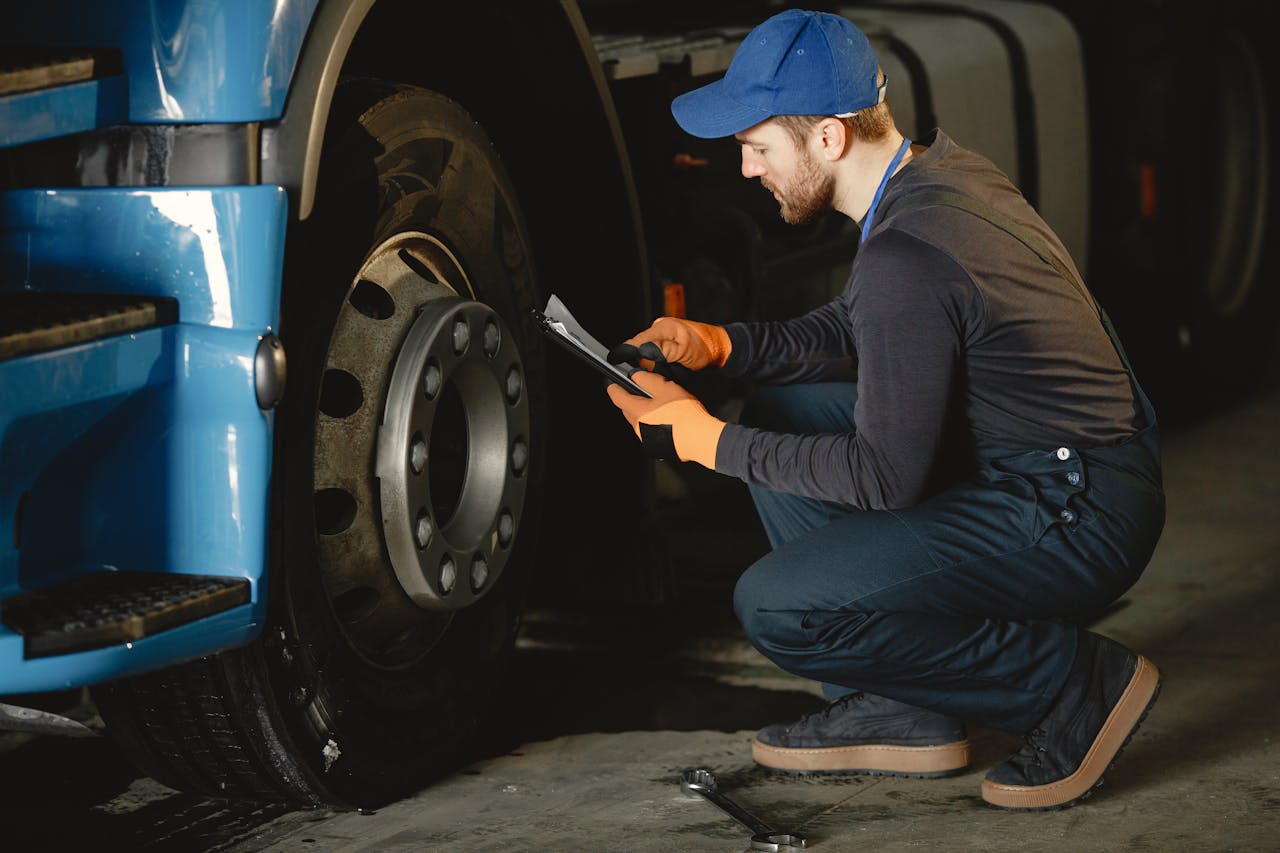
- Walk-around: visible damage, fluid leaks under tractor and trailer, tire condition, lug nut markings (any spun lugs?)
- Lights: headlights, brake lights, turn signals, marker lights, trailer lights
- Tires: visual check for cuts, bulges, low pressure; legal tread depth (4/32″ steer, 2/32″ drive/trailer in US)
- Brakes: air pressure build to 120 PSI, parking brake test, low-air warning at 60 PSI, push-rod travel within spec
- Coupling: fifth wheel locked, kingpin secure, glad hands connected
- Fluids: engine oil, coolant, washer fluid, power steering
- Suspension: visible air bag inflation, no broken leaf springs
- Cargo securement: straps, chains, tarps
Weekly
- Tire pressure on all 18 wheels with a calibrated gauge
- Wheel inspections – look for marker paint shift on lug nuts
- Battery terminals – clean of corrosion
- Fluid top-offs – engine oil, washer fluid, DEF
- Air dryer purge – check that air dryer is purging correctly
- Trailer suspension and braking
- Mud flaps and reflectors – DOT inspection items
Monthly
- Engine compartment inspection – belts, hoses, leaks
- Air filter inspection – replace when restriction indicator triggers
- Cabin air filter – driver comfort and HVAC performance
- Fuel filter water drain – pull water out of the fuel/water separator
- Slack adjusters – verify within spec
- Wheel bearing temperature – feel each hub after a drive; significantly hotter than others indicates problem
Every PM service (typically 15,000-25,000 miles)
- Engine oil and filter change – synthetic blend or full synthetic for modern engines
- Fuel filters – primary and secondary
- Differential and transmission oil – check, top up; full change at manufacturer intervals (100,000-250,000 miles)
- Greasing – fifth wheel, drive shafts, suspension points
- Brake adjustment and inspection
- Cooling system inspection
- Belt and hose inspection
- Battery load test – especially before winter
Annual / DOT inspection prep
- Comprehensive brake inspection – drum thickness, lining wear, push-rod travel
- Steering and suspension – kingpin slack, ball joint wear, tie-rod ends
- Fifth wheel inspection – bracket wear, jaw condition
- Frame inspection – cracks at high-stress points
- Emissions system – DPF, EGR, DEF
Tire management – the main expense line
Tires are one of the largest operating costs after fuel:
- Pressure monthly – underinflated tires wear faster and use more fuel
- Alignment – annually or whenever irregular wear patterns appear
- Retread vs new – drive and trailer position can use retreads; steer should be new only
What NOT to skimp on
- Brake work. Lost brakes have killed drivers and families. Annual brake inspection is important.
- Steering components. Loose tie-rod ends have caused fatal crashes.
- Tire condition. Blowouts at highway speed are catastrophic.
The cost case
A consistent owner-operator running PM at manufacturer-recommended intervals typically gets:
- 700,000-1,000,000 miles on engine before major rebuild
- 250,000-400,000 miles on transmission
A maintenance record is part of the asset
Daily pre-trip, weekly pressure and lights check, monthly engine compartment inspection, scheduled PM at manufacturer intervals, and annual DOT inspection prep are the checks that repay the effort. Maintenance is the highest-ROI line item in trucking. In order to get the best return, we recommend you follow your specific truck manufacturer’s service manual and consult an qualified diesel technician for anything beyond routine inspection.
A maintenance log that is useful on a busy week
A good maintenance record is brief enough to be completed and detailed enough to show what changed. Record the date, odometer or engine hours, defect, action taken, parts used and who released the truck. Attach invoices and photographs when they help explain recurring wear.
Do not let small observations disappear into text messages or memory. A slow air-pressure build, uneven tire wear or a light that works intermittently may not stop the truck today, but repeated notes can expose a pattern before it becomes roadside downtime.
Separate three types of work
- Driver observation: what was seen, heard or felt during inspection and operation.
- Scheduled service: work due by time, distance, hours or manufacturer instruction.
- Defect repair: a specific fault that must be assessed and closed by an authorised person.
Use local workshop costs and your own downtime history
Roadside repair, towing and lost work can make an unplanned failure much more expensive than scheduled service, but the amount varies by route and contract. Build the maintenance budget from invoices, service intervals and actual days unavailable.
Measure the value of preventive maintenance through fewer repeat defects, better inspection results and more predictable availability. Avoid universal claims about percentage savings; a well-kept log will show what the programme does for this truck.
Schedule the next service before the truck leaves
Record the next due point on the work order and in the fleet calendar. Where parts have long lead times, order them before the service window. Planned downtime is easier to manage when dispatch knows about it early.
Next steps
- Essential Truck Driver Safety Tips for New CDL Holders
- Brake Inspection Checklist for Every Driver
- Tire Maintenance Guide: Pressure, Tread, Rotation, Replacement
Using telematics data to plan maintenance
A checklist tells you what to inspect; telematics tells you when something is drifting before the checklist catches it. Heavy trucks report continuously through the engine control unit and telematics hardware, and a handful of those signals are genuinely useful for planning work – engine fault codes, coolant temperature trends, fuel-economy drift, idle hours against distance covered, and harsh-braking events that point at both driving style and brake wear.
The distinction worth holding on to is between three ways of working. Reactive maintenance fixes things after they break. Preventive maintenance services components on a fixed schedule, which is what the checklist above is for. Predictive maintenance uses the truck’s own data to bring a job forward or push it back based on how the vehicle is actually being used. A rising coolant temperature trend, for example, is a reason to inspect the cooling system at the next convenient stop rather than wait for the scheduled service or the roadside.
You do not need an enterprise platform to start. Acting on the fault codes and fuel-economy trends your existing tracking already produces covers most of the value, and it works for a single owner-operator as well as a large fleet. What it does not do is replace scheduled servicing – it tells you where to look first and which jobs cannot wait, while the fixed intervals still govern the rest.
Related guides
Sources and Further Reading
- FMCSA inspection, repair and maintenance guidance
- FMCSA commercial vehicle inspection guidance
- NHTSA vehicle recall lookup
- FMCSA Inspection, Repair and Maintenance Guidance
- FMCSA Commercial Vehicle Inspection Guidance
- NHTSA Vehicle Recall Lookup
Maintenance intervals and defect decisions belong to the manufacturer, operator and authorised workshop; this checklist helps organise the conversation.