Reviewed for safety and technical accuracy by an Auto Drive Tips subject-matter contributor. Road rules, licensing, and vehicle regulations vary by country and state — always verify the requirements that apply where you drive before relying on this guidance.
The cheapest breakdown is the one that never happens. Predictive maintenance uses the data a modern truck already generates to replace parts just before they fail — not on a rigid calendar, and not after a costly roadside breakdown. For owner-operators and fleets, it is one of the biggest levers on both safety and running cost.
Reactive, preventive, and predictive maintenance
Reactive maintenance fixes things after they break. Preventive maintenance services components on a fixed schedule regardless of condition. Predictive maintenance goes a step further: it watches how a component is actually behaving and acts when the data shows it is heading toward failure. Predictive scheduling reduces both surprise breakdowns and the waste of replacing parts that still had life in them.
What telematics actually measures
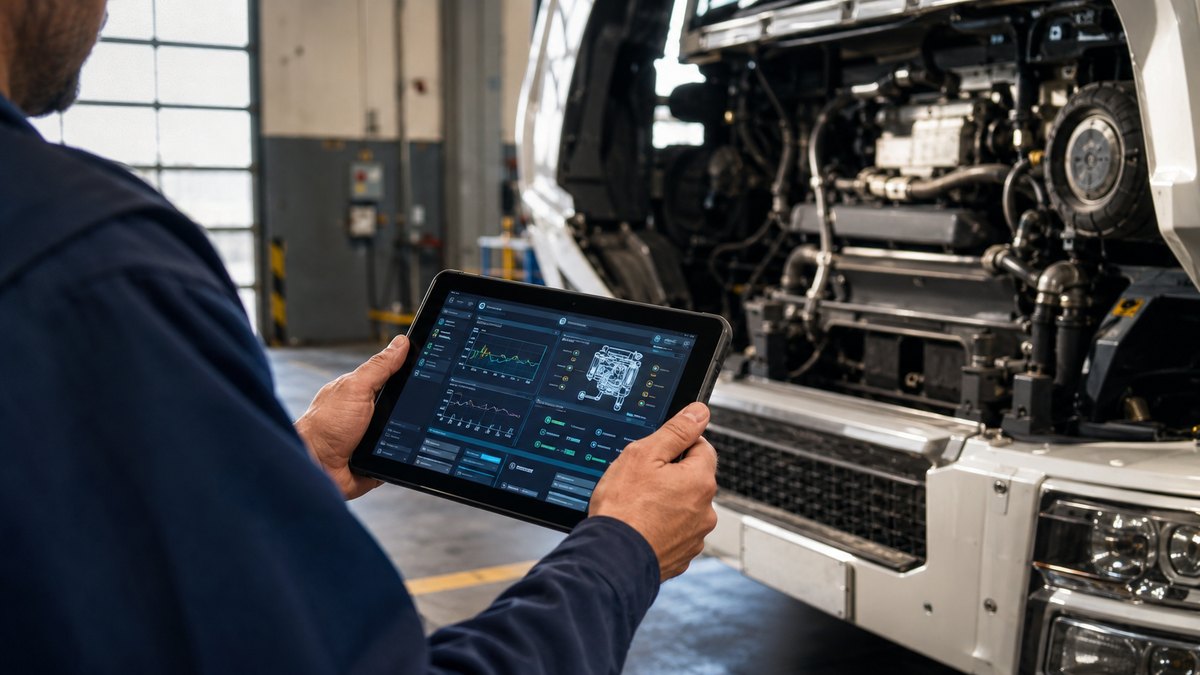
Heavy trucks continuously report data through the engine control unit and telematics hardware. Useful signals include:
- Diagnostic trouble codes (DTCs) and fault warnings, sent to dispatch in real time.
- Engine hours, load, and fuel-burn trends that reveal developing inefficiency.
- Fluid and temperature readings — coolant, oil, and exhaust after-treatment status.
- Brake and tyre-pressure data where sensors are fitted.
- Harsh-braking and idling patterns that flag driver-related wear.
Turning data into a maintenance decision
| Telematics signal | Predictive action |
|---|---|
| Rising coolant temperature trend | Inspect the cooling system before it fails on the road |
| Recurring after-treatment fault codes | Schedule service to avoid a derate or breakdown |
| Gradual drop in fuel economy | Check injectors, air filter, tyres, and driver behaviour |
| Falling tyre pressure on one axle | Inspect for a slow leak before a blowout |
The payback: uptime and safety
A truck stranded on the shoulder costs recovery fees, a missed delivery, and driver hours — and a mechanical failure at speed is a serious safety event. By catching a failing water pump, injector, or brake component early, predictive maintenance keeps vehicles in service and off the hard shoulder. It also builds a documented maintenance record, which supports compliance with roadworthiness rules such as those enforced by the FMCSA and equivalent authorities.
Getting started without over-investing
You do not need an enterprise platform on day one. Start by acting on the fault codes and fuel-economy trends your existing telematics already reports, set alert thresholds for the failures that hurt most, and keep a simple log linking alerts to the repairs that followed. Over time that history tells you which components to watch and when to replace them. Pair the data with your manufacturer’s recommended service intervals rather than abandoning them.
Frequently asked questions
Is predictive maintenance only for big fleets?
No. Even a single owner-operator can benefit by acting on the engine fault codes and fuel-economy trends the truck already reports, which helps avoid roadside breakdowns.
Does telematics replace scheduled servicing?
No. It complements manufacturer service intervals by catching developing faults between services, so you fix problems before they cause a failure.
What is the biggest benefit of predictive maintenance?
Uptime and safety. Catching a failing component early keeps the truck earning, avoids expensive roadside recovery, and reduces the risk of a mechanical failure while driving.