Road rules, licensing, and vehicle regulations vary by country and state – always verify the requirements that apply where you drive before relying on this guidance.
Driving a manual car looks intimidating from the passenger seat and feels clumsy for the first hour, then quickly becomes second nature. The whole skill rests on understanding one thing, the clutch and its friction point, after which gear changes and hill starts fall into place with a little practice.
What the clutch actually does
The clutch connects and disconnects the engine from the wheels. Pressed fully, it disconnects them so you can change gear or stop without stalling; released, it connects them so the engine drives the car. The key concept is the friction point, the position where the clutch starts to bite and the car begins to move. Learning to feel that point is the foundation of everything else.
Finding the friction point
On flat ground with the engine running and the handbrake on, press the clutch fully, select first gear, then slowly raise the clutch until you feel the car strain gently and the engine note dip, that is the friction point. Practise easing the clutch up to that point and back down a few times to learn where it sits. Once you can find it consistently, pulling away smoothly is mostly about patience at that point.
Pulling away smoothly
To move off, bring the clutch slowly to the friction point while gently adding a little accelerator, then continue easing the clutch up as the car gathers pace, releasing the handbrake as it starts to pull. Too little gas or lifting the clutch too fast stalls the engine; too much gas revs it noisily. Smoothness comes from coordinating a gentle clutch release with steady throttle, and it improves rapidly with repetition, as with all the fundamentals in our new driver guide.
Changing gears
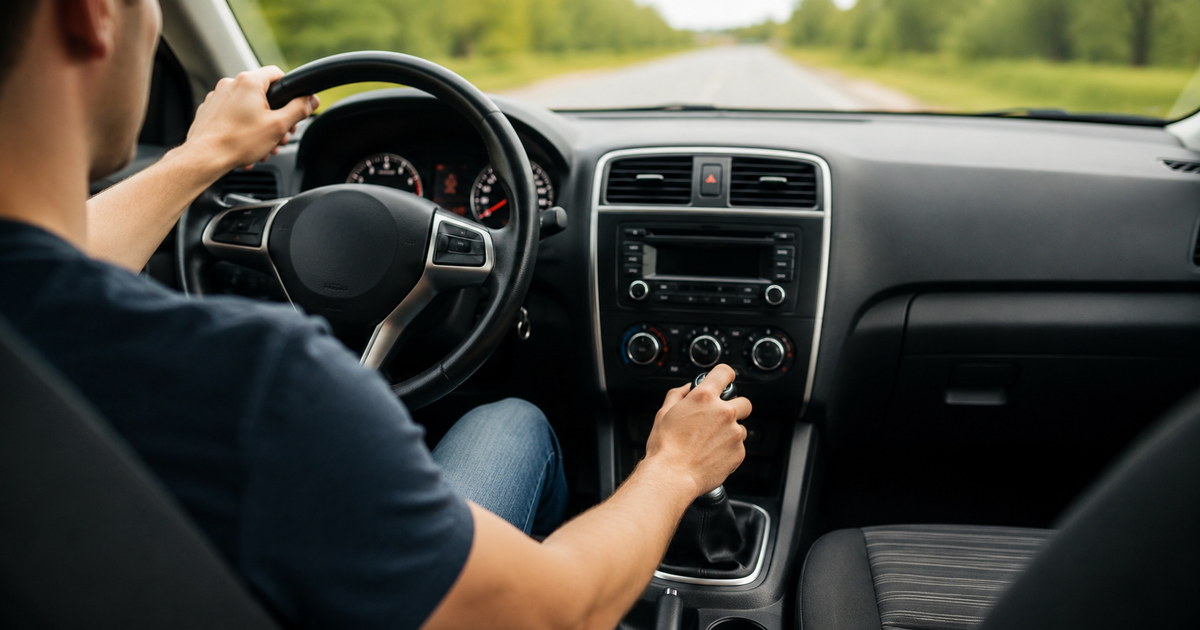
To change up, ease off the accelerator, press the clutch fully, move the lever to the next gear, then release the clutch smoothly while gently reapplying gas. Change up as the engine rises to a comfortable pace and change down before it labours, matching the gear to your speed. Smooth, unhurried movements beat fast, jerky ones, and the timing becomes instinctive once you stop thinking about each step.
Hill starts without rolling back
Starting on an uphill is where new manual drivers worry most, because the car can roll back. The reliable method is to hold the car on the handbrake, bring the clutch to the friction point and add a little gas until you feel the car wanting to pull, then release the handbrake as you continue easing the clutch up. Done right, the car moves forward without rolling. Practising this on a gentle slope builds the confidence to handle steep ones.
Protect the clutch
A few habits prolong clutch life. Do not ride the clutch by resting your foot on it while driving, do not hold the car on the clutch at the friction point at junctions when the handbrake would do, and use the handbrake rather than clutch-balancing on hills. Smooth changes and not slipping the clutch unnecessarily keep it healthy, which also supports the steady, efficient style in our fuel-saving habits guide.
Practise low-stakes first
Learn in a quiet, flat area with no traffic before tackling hills and junctions, and expect to stall a few times, everyone does, simply restart calmly. Within a few sessions the coordination becomes automatic and you stop thinking about the clutch at all. A manual gives you more direct control over the car, and once mastered it is a genuinely satisfying and useful skill, especially if you ever drive abroad where manuals are common.
Manual driving checklist
To get comfortable with a manual:
- Learn the friction point on flat ground first.
- Pull away by easing the clutch up with gentle gas.
- Change gear: ease off, clutch in, shift, clutch out smoothly.
- On hills, hold on the handbrake and use the friction point to avoid rolling back.
- Don’t ride or slip the clutch unnecessarily.
Stopping, junctions and reverse
A few more habits round out manual driving. When slowing to a stop, press the clutch fully just before the car would stall so the engine keeps running, and at a standstill it is generally best to be in neutral with the handbrake on rather than holding the clutch down at a junction. When setting off again, return to first. Reversing uses the same friction-point control as pulling away, just gently and with extra care for what is behind, as our new driver guide stresses. On downhills, leaving the car in gear lets engine braking help control speed rather than coasting in neutral. None of this is difficult, but practising stops, junction starts and reversing in a quiet area until they feel natural means you are not caught out the first time you face a busy junction on a slope with traffic behind you.
Sources
- The Highway Code: general rules, techniques and advice, rules 103-158 (UK)
- US DOE fueleconomy.gov: driving habits and efficiency
Clutch feel and gearing vary by car. Practise in a safe, quiet area, and consult a qualified instructor if you are learning to drive.