Reviewed for safety and technical accuracy by an Auto Drive Tips subject-matter contributor. Road rules, licensing, and vehicle regulations vary by country and state — always verify the requirements that apply where you drive before relying on this guidance.
Advanced driver assistance systems are no longer a luxury-car feature — they are standard across new commercial vehicles, and they change how fleets must maintain them. Understanding what these systems do, and the calibration they demand, protects both drivers and the fleet’s bottom line.
What is ADAS?
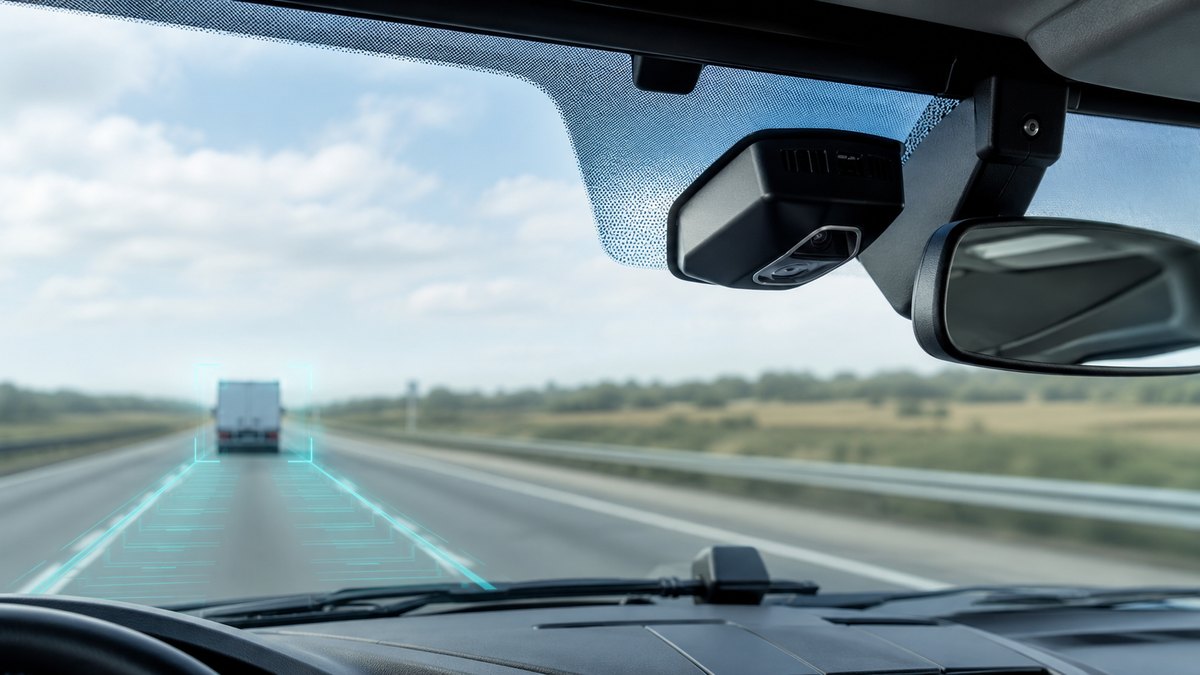
ADAS stands for Advanced Driver Assistance Systems — the sensors and software that help a driver avoid or reduce crashes. In commercial vehicles the common features are Automatic Emergency Braking (AEB), lane-departure warning and lane-keeping assist, adaptive cruise control, blind-spot monitoring, and forward-collision warning. They rely on cameras, radar, and sometimes ultrasonic or lidar sensors mounted around the vehicle.
How does ADAS differ in heavy vehicles?
The principles are the same as in a car, but a loaded truck’s mass and long stopping distance mean the systems are tuned differently and intervene earlier. Adaptive cruise control manages far larger gaps, and AEB has to account for a trailer’s weight. Because heavy vehicles cause more damage in a collision, these systems deliver an outsized safety benefit — which is exactly why fleets are adopting them.
The calibration duty managers overlook
This is the point most fleets get wrong. ADAS sensors must “see” the road with millimetre accuracy, so they need recalibration after events that seem unrelated to the electronics, including:
- Windshield replacement — the forward camera usually sits on the glass and must be recalibrated to its new position.
- Wheel alignment or suspension work — changes the vehicle’s geometry and the sensors’ aim.
- Bumper, grille, or mirror repairs — where radar and blind-spot sensors are mounted.
- Sensor removal or a reported fault code.
Skipping calibration can leave a system that looks fine but brakes late or reads the lane incorrectly — a hidden safety risk and a liability exposure.
Building ADAS into fleet maintenance
| Trigger event | Fleet action |
|---|---|
| Glass replacement | Book static or dynamic camera recalibration before the vehicle returns to service |
| Alignment / suspension repair | Verify sensor aim and recalibrate as specified by the manufacturer |
| ADAS warning light or fault code | Diagnose before dispatch; do not clear codes and release the vehicle |
| Routine servicing | Include sensor cleaning and a functional check in the schedule |
Driver training still matters
ADAS assists the driver; it does not replace them. Drivers need to understand each system’s limits — for example, that cameras struggle in heavy rain, snow, or direct glare, and that lane assist can be fooled by faded markings. Fleets that pair the technology with clear driver briefings see the biggest safety gains. Independent bodies such as the Insurance Institute for Highway Safety publish research on how these crash-avoidance features perform, which is useful when choosing specifications for new vehicles.
Frequently asked questions
Does a windshield replacement really need ADAS calibration?
Yes, on most vehicles with a windshield-mounted forward camera. The camera’s angle changes with the new glass, and recalibration restores accurate lane and collision detection.
Can drivers rely on automatic emergency braking?
It is a safety net, not a substitute for attentive driving. AEB can reduce or avoid impacts but has limits in poor weather and at high closing speeds, so drivers must stay in control.
How often should fleet ADAS sensors be checked?
Include a sensor clean and functional check at each routine service, and recalibrate whenever glass, alignment, or relevant bodywork is repaired or a fault code appears.