Booking the wrong size vehicle is the most common and costly mistake in group travel. Hire a full coach for 18 people and you pay for empty seats; squeeze 30 into minibuses and you lose luggage space, comfort, and onboard facilities. This guide helps organisers match the vehicle class to the itinerary.
What counts as a minibus, and what counts as a coach?
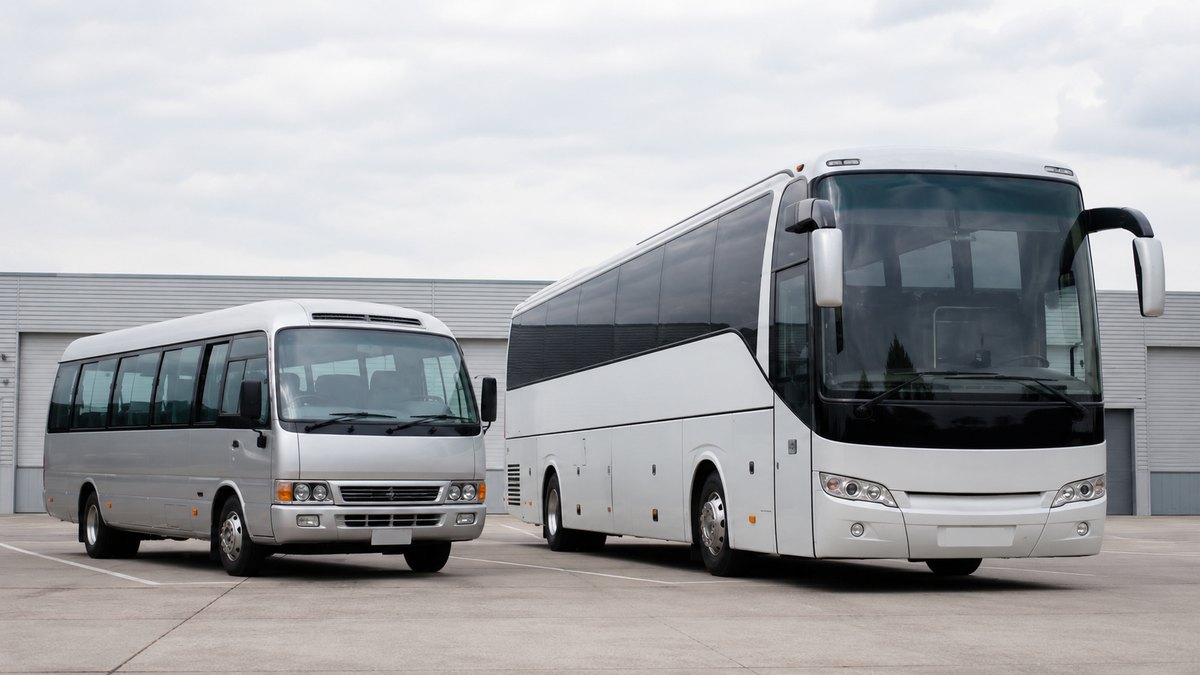
A minibus typically seats around 15 to 25 passengers, is based on a van platform, and is easy to manoeuvre in towns and car parks. A full-size charter coach seats roughly 49 to 57, sits higher, and carries luggage in a large undercarriage hold, often with a restroom, climate control, and reclining seats for long-distance comfort.
Minibus vs charter coach: side by side
| Factor | Minibus (15–25) | Charter coach (49–57) |
|---|---|---|
| Best for | Short transfers, small groups, tight urban routes | Long-distance travel, large groups, multi-day tours |
| Luggage | Limited — rear space or roof | Large undercarriage hold |
| Onboard amenities | Basic; usually no restroom | Restroom, climate control, reclining seats, often Wi-Fi |
| Access & parking | Easy in towns and small venues | Needs coach-friendly access and parking |
| Cost efficiency | Cheaper for small numbers | Lower cost per seat when near capacity |
How to choose the right size
- Count people and luggage, not just seats. A ski trip or airport run needs far more hold space per person than a local shuttle.
- Think about the journey length. Anything over about two hours favours a coach with a restroom and reclining seats.
- Check the route and venues. Historic town centres, narrow lanes, and small car parks may rule out a full coach.
- Allow a comfort margin. Booking to the exact seat count leaves no room for a last-minute addition; a small buffer is usually worth it.
- Consider two minibuses vs one coach. Two vehicles add flexibility for split itineraries but usually cost more per seat than a single full coach.
Worked examples
A 30-person corporate retreat, three hours away: one charter coach is usually the best value and most comfortable, with a restroom for the long leg and a single pick-up point. A 16-person site visit around a city: a minibus is more agile and cheaper, and parks where a coach cannot. A 45-person multi-day tour: a full coach with a large hold and onboard facilities is the clear choice.
Questions to ask the operator
Confirm the exact seat count and luggage capacity, driver-hours limits for long days, accessibility options if any passenger needs them, and what happens if numbers change. Reputable operators run vehicles that meet the passenger-carrier safety rules set by authorities such as the FMCSA in the United States (or the equivalent regulator in your country), so ask about their safety and maintenance standards too.
Frequently asked questions
What size bus do I need for 30 people?
For 30 passengers with luggage on a longer trip, a single full-size coach is usually the most comfortable and cost-effective option. For a short local transfer, two minibuses can also work.
Is a minibus cheaper than a coach?
For small groups, yes. But once you approach a coach’s capacity, the cost per seat on a full coach is often lower than running multiple minibuses.
Do charter coaches have toilets?
Most full-size touring coaches do, along with climate control and reclining seats. Minibuses generally do not, which is why journey length is a key factor in choosing.