Renting a car abroad is less about finding the lowest daily rate and more about confirming that the driver, vehicle and agreement fit the trip. Licence rules, insurance language, deposits and road systems can all differ from what you use at home.
Start with the driving documents
Check the destination’s official guidance before booking: some countries accept a foreign licence on its own, while others require an International Driving Permit alongside the original. The permit is a translation document rather than a replacement licence, and it has to come from an authorised issuer in your home country before you travel – our guide to International Driving Permits covers who is allowed to issue one and what to watch for.
The rental company may apply its own conditions as well. Ask about the minimum time the licence must have been held, age restrictions, additional drivers and the card required for the deposit. Do not assume that being legally allowed to drive automatically means the rental desk will release every vehicle class.
Compare the total booking, not the headline rate
- Location charges: Airport, station or premium-location fees may appear later in the booking flow.
- Distance allowance: Check whether the rental includes unlimited distance and what happens when the limit is exceeded.
- Equipment: Child seats, winter equipment, toll devices and additional drivers can materially change the final amount.
- Fuel or charging: Understand the return level and where the vehicle can realistically be refuelled or charged.
- Cross-border use: Written permission, equipment or extra cover may be required before taking the car into another country.
Read the cancellation and payment rules
A prepaid booking may be less flexible than a reservation paid at collection. Check what happens after a flight delay, missed pickup time or change of branch. The cardholder may need to be present, and the desk may require a credit card rather than a debit card for the security hold.
Keep the booking confirmation offline. It should show the vehicle class, included items, agreed price basis and cancellation terms. If the counter offers a different agreement, compare it before signing rather than relying on a verbal explanation.
Work out what insurance already applies
Rental protection is confusing because several products may cover different risks. The rental company may offer a damage waiver, liability protection, personal accident cover or protection for glass, tires and personal belongings. Your own motor policy, travel insurance or payment card may also provide limited cover.
Ask each provider to confirm the exact vehicle class, country, rental duration, authorised drivers and exclusions. A card benefit that covers collision damage may not cover liability, administrative charges, loss of use or an unauthorised road. Keep written evidence and the claim instructions.
Inspect the car before leaving
- Photograph every side, the wheels, glass, roof where safely visible and the interior.
- Record the odometer, fuel or battery level and any warning lights.
- Check the spare wheel or repair kit, required safety equipment and charging cable where relevant.
- Make sure existing damage appears on the condition report before the vehicle moves.
- Test lights, wipers, mirrors, climate controls and navigation while still at the branch.
Learn the first hour of driving before the trip begins
Road signs, parking rules, toll systems, low-emission zones and the side of the road may be unfamiliar. Plan the first route in advance and avoid collecting the car at the end of a long flight if the driver is tired. Set navigation while parked and keep the rental company’s emergency number available.
Return the car with evidence
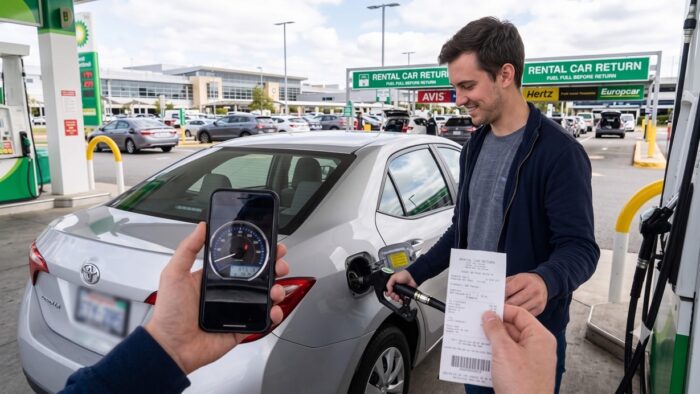
Allow time for refuelling or charging, unloading and a final walk-around. Photograph the same areas again and obtain a receipt showing the return time and recorded level. If the branch is closed, read the after-hours process carefully because responsibility may continue until the vehicle is inspected.
A calm booking is usually the cheaper booking
Confirm eligibility first, compare the complete agreement, document the vehicle and keep important terms in writing. That approach is more reliable than trying to solve insurance, tolls and licence questions at a busy counter in another country.
Keep a one-page rental file
Save the booking, licence requirements, insurance confirmation, branch address and roadside number in one place. Add a screenshot of the return location and the local emergency number. This avoids searching through several apps when mobile data is weak or the counter is closing.
For a multi-country trip, keep a separate note for each border. Include permission to cross, toll or vignette needs, low-emission zones and any equipment the car must carry. Rules that apply in the collection country may not cover the next one.
Choose a car the driver can operate comfortably
An unfamiliar transmission, larger body or different driving side can add pressure after a flight. Choose a size that fits the luggage without making parking and narrow roads unnecessarily difficult. Before leaving, practise the indicators, lights, parking brake, gear selector and refuelling or charging door while the car is stationary.
Related guides on Auto Drive Tips
- International Driving Permits: A Practical Guide
- Car Rental Insurance Explained: What You May Need
- Airport Car Rental Mistakes to Avoid in 2026
Sources and Further Reading
- USAGov international driving permit guidance
- FTC consumer guidance on renting a car
- USAGov: International Driving Permits
- FTC Consumer Advice on Renting a Car
Before travel, compare these references with the destination’s licence rules and the rental agreement issued for the booking.