Road rules, licensing, and vehicle regulations vary by country and state – always verify the requirements that apply where you drive before relying on this guidance.
Electric vans have moved from curiosity to a normal option on most order books, and the sales pitch is simple: cheaper per kilometre, quieter, cleaner, and welcome in low-emission zones. All of that can be true. What decides whether it works for your business is narrower than the pitch, and it comes down to three things – what you carry, where you park overnight, and how predictable your day is.
Where an electric van genuinely fits
The strongest case is a van that does a known, repeatable distance and comes home to the same place every night. Multi-drop delivery, trades working a defined radius, service rounds, anything with a depot or a driveway at the end of it. Predictable distance means you can size the battery honestly instead of buying range as insurance.
The weakest case is the opposite: long or irregular distances, no reliable overnight parking, or work where the day can double in length without warning. Public rapid charging will cover that, but it costs considerably more per kilowatt-hour than charging at base, and the time spent waiting is time not working.
Payload: the trade-off nobody mentions
Batteries are heavy, and that weight comes out of what the van can legally carry. An electric van and its diesel equivalent can look identical in the brochure and differ meaningfully once you compare payload figures, which is exactly the number a working van lives or dies by.
Check the payload of the specific model and battery size you are quoting for, not the model family, and check it against what you actually load rather than what you think you load. If you are near the limit in a diesel van today, you may need to move up a size – and that changes the economics, the parking and sometimes the licence category. Weigh a typical load if you have any doubt.
Charging is the real decision
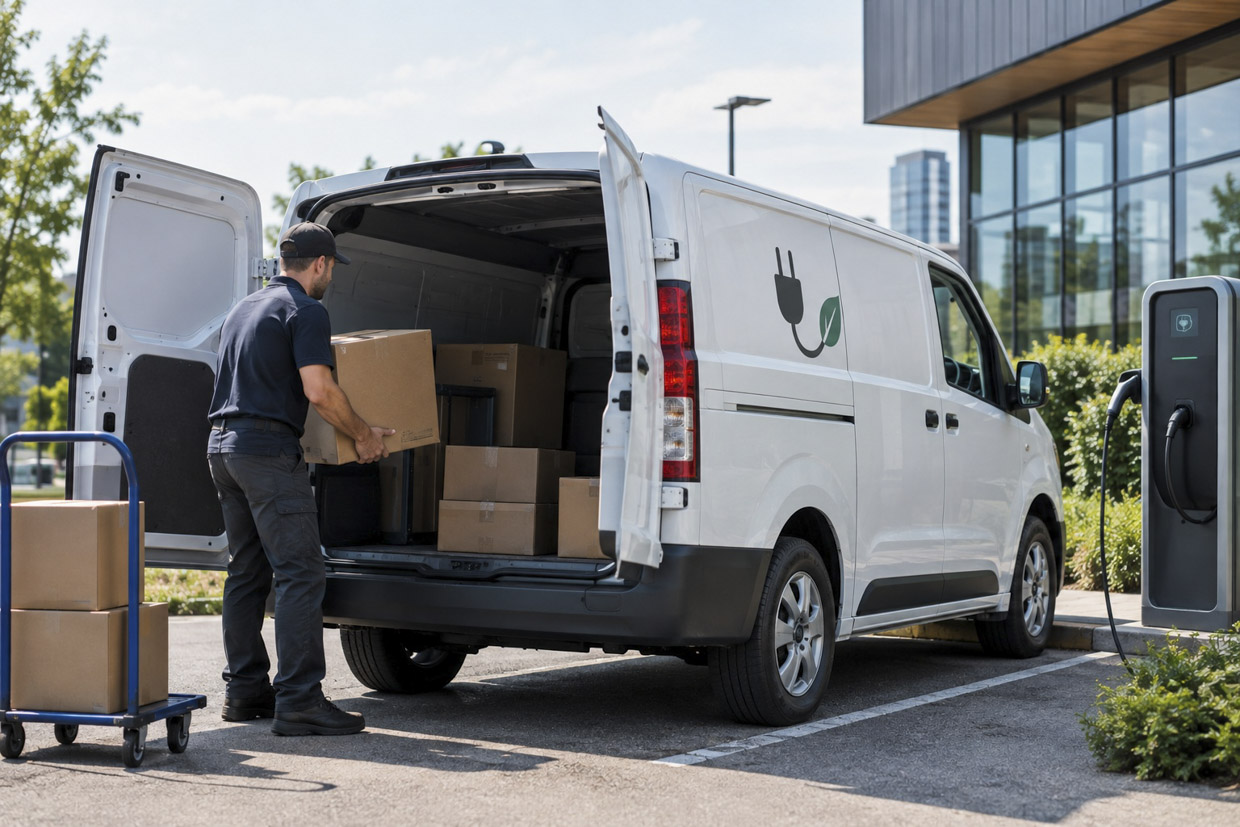
Where the van charges overnight matters more than the van itself. A dedicated charge point at your premises or at the driver’s home is the whole business case: cheap off-peak energy, a full battery every morning, no queueing. A three-pin socket is a fallback, not a plan.
Two questions decide it. Can you get a charge point installed where the van actually sits overnight, and is the supply there strong enough? If the van lives on the street, or in shared parking, or if your unit’s supply is already stretched, resolve that before ordering the vehicle. Plenty of electric vans have been bought before anyone checked the parking.
If you run more than a couple of vans, the same problem scales into a site-power question rather than a charger question.
What the UK grant is currently worth
The UK still discounts zero-emission vans through a government grant, applied by the dealer rather than claimed by you. As it stands the maximum discount is £2,500 for a small van and £5,000 for a large one.
The eligibility bands are defined by weight and capability: a small van is under 2,500 kg gross weight, a large van between 2,500 kg and 4,250 kg, and in both cases the vehicle must emit 0 gCO2/km and travel at least 96 km with no emissions. Grant funding is limited and the terms change, so confirm what is available at the point of ordering.
Outside the UK the incentive landscape is completely different – some countries offer purchase grants, others tax relief, others nothing – so treat any headline price you see quoted online as local to wherever it was written.
Running costs against purchase price
An electric van usually costs more to buy and less to run. Whether that trade works depends almost entirely on your annual distance and your electricity price, which is why a general answer is worthless and your own arithmetic is not.
Work it as a total cost of ownership question over the years you will actually keep the van: purchase or finance, energy at your real charging mix rather than the best-case home rate, servicing, tyres, insurance, and what you expect it to be worth at the end. Residual values for electric vans are still less settled than for diesel, which is a genuine uncertainty rather than a reason to avoid them.
Questions to answer before you order
- What is the payload of this exact model and battery, and does it cover your heaviest normal load?
- Where does the van park overnight, and can a charge point be installed there?
- What is the longest day this van realistically does, not the average one?
- What does your electricity actually cost at the times you would charge?
- What grant or tax treatment applies where you are buying, confirmed at order?
- What happens on the day the van cannot charge – is there a fallback, or does work stop?
Related guides
- How to Choose a Van for a Small Business
- Van Racking and Load Security: Setting Up a Work Van
- Fleet Electrification: Planning the Switch to EVs
- Home EV Charging Guide