Road rules, licensing, and vehicle regulations vary by country and state – always verify the requirements that apply where you drive before relying on this guidance.
A work van fills up whether you plan it or not. The difference between a van that is organised and one that is merely full shows up in two places: how long it takes to find anything, and what happens to the contents under heavy braking. The second is the one that matters, and it is a legal question as much as a practical one.
An insecure load is a legal problem
It is tempting to treat load security as housekeeping. It is not. UK guidance for vehicle operators states that everyone involved in loading a vehicle or managing a transport operation is responsible for making sure the load is safely loaded, secure during transport and safely unloaded – a duty that reaches operators, drivers and the people sending the goods alike.
The consequences are stated just as plainly: depending on the circumstances, driving with an insecure load can be classed as careless or dangerous driving, and it can result in a custodial sentence in the most serious cases where someone is killed or injured. Most countries frame this differently in detail, but the underlying principle – that the load is somebody’s legal responsibility – is close to universal.
What racking actually buys you
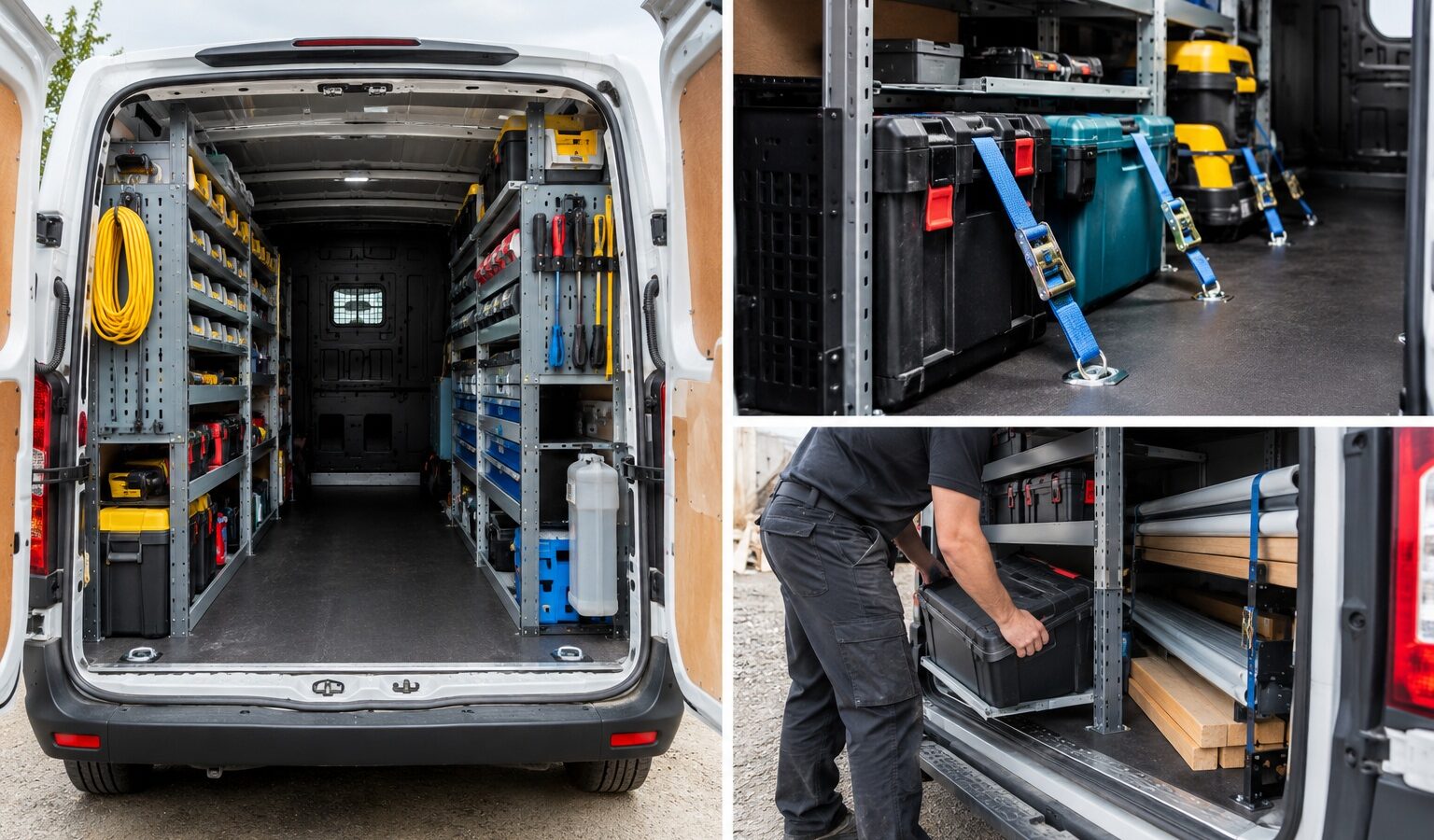
Racking does three things. It stops loose items becoming projectiles, it stops weight migrating around the load area, and it makes the van faster to work out of. The first is the safety case; the other two are why people actually fit it.
What racking does not do is secure everything by itself. Open shelving holds items that fit its shelves. Anything heavy, awkward or round still needs restraining, and a rack full of unsecured tools is a rack that empties itself under braking.
Planning the layout around the job
Lay the van out around the work rather than around the van. A few questions settle most of it: what comes out at every job, what comes out occasionally, what never comes out, and what is heavy.
- Everyday items at waist height near the doors, so the common reach is the easy one.
- Heavy items low and as close to the axle line as the layout allows, not high and not at the very back.
- Consumables in closed bins rather than open shelves, where they will not migrate.
- Long items along one side with a dedicated restraint, not laid across the top of everything else.
- A deliberate empty space for whatever the job of the day adds – the space you do not plan for is the space that becomes a hazard.
Securing what racking cannot hold
Load straps, cargo bars and lashing points cover what shelving cannot. The point to understand is that a restraint has to resist the forces of an emergency stop, not simply stop things sliding around on a roundabout – which is why bungee cords are not load restraint, however common they are.
Check the lashing points themselves as part of the vehicle checks. They are structural, they corrode, and a restraint is only as good as what it is anchored to.
Weight, payload and where it sits
Racking has weight of its own, and it comes out of the payload before you have loaded a single tool. A full metal rack-out can account for a meaningful share of a small van’s payload, and that share is permanent.
Work out the payload with the racking fitted, then load to that figure rather than to the brochure number. Where the weight sits matters as much as how much there is: high or rearward weight makes the van handle differently in crosswinds and under braking, and it is felt most on exactly the days you would rather it were not.
Security when the van is parked
Load security and theft security are different problems that share a solution. Tools stored in locked bins and secured to the vehicle are both restrained in motion and harder to remove quickly when the van is unattended.
Keep a written inventory with serial numbers, and photograph the layout. It shortens the insurance conversation considerably, and it is far easier to compile on a quiet afternoon than after a break-in.
Getting it right the first time
Racking is expensive to redo and easy to over-specify. Work out of the van unmodified for a few weeks first, note what you reach for and what you move out of the way, and buy to that. The layout that survives is the one built around how the work actually happens, not the one that looked tidiest in the catalogue.
Related guides
- How to Choose a Van for a Small Business
- Cargo Van and Box Truck Rental Guide
- Cargo Van vs Pickup Truck: Which Is Right for Your Business?
- Refrigerated Van Basics for Business
- Electric Vans for a Small Business