Road rules, licensing, and vehicle regulations vary by country and state – always verify the requirements that apply where you drive before relying on this guidance.
A bridge strike is rarely a moment of carelessness at the bridge. It is the end of a chain that started with a height nobody rechecked after a trailer swap, a route planned by a car satnav, or a driver who genuinely did not know how tall the vehicle was that morning. The same is true of weight-limit violations. Both are planning problems, and both are solvable before the wheels turn.
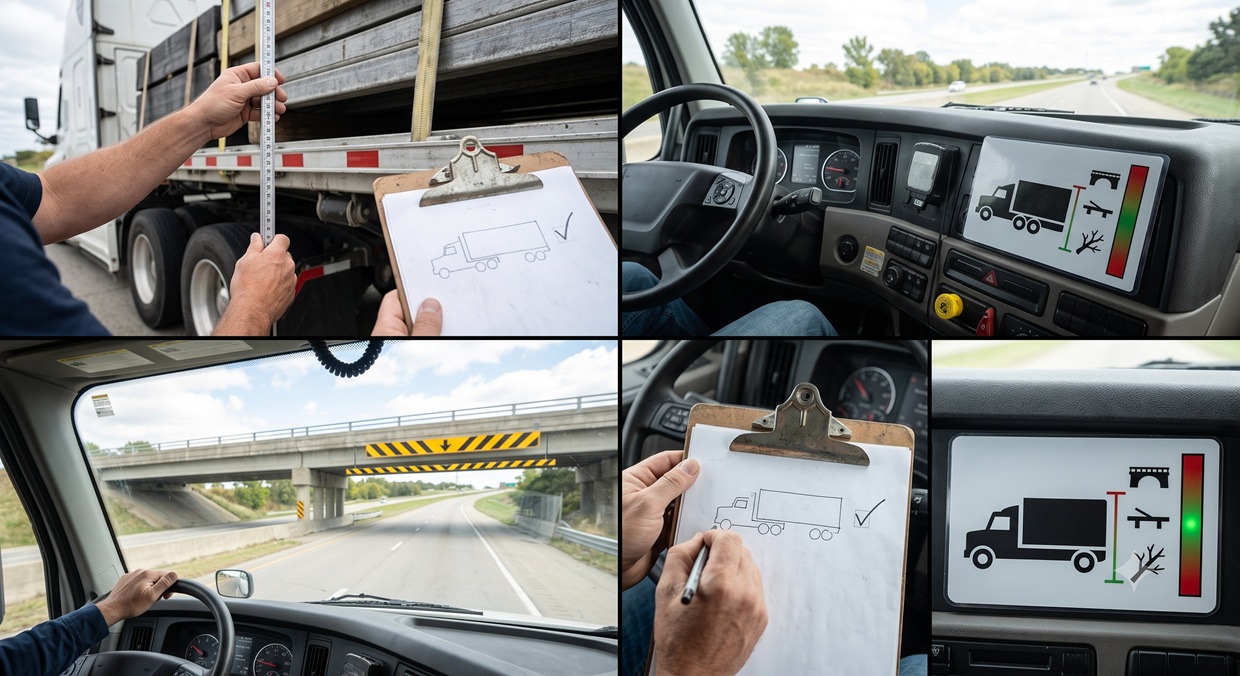
Establish the real running height
The height that matters is the height of the vehicle as it is loaded and coupled today, not the figure on the original specification. Trailer swaps, different fifth-wheel settings, air suspension, a roof-mounted unit, even tyre pressures and load all move the number.
The UK Traffic Commissioners’ guidance to operators puts the duty squarely on the operator: each vehicle and trailer in the fleet should have an established running height recorded on its technical record. That means measuring it, writing it down, and rechecking it when the configuration changes – not carrying it in someone’s head.
Put the height where the driver can see it
A height recorded in the office protects nobody at three in the morning on an unfamiliar diversion. It needs to be in the cab, visible from the driving position, and correct for the vehicle as currently configured.
Where drivers work across jurisdictions that use different units, the same guidance recommends making height conversion charts available – a metric height is of limited use in front of a sign in feet and inches, and the mental arithmetic is exactly what fails under pressure.
Plan the route before the wheels turn
The operator guidance is explicit that routes should be assessed for risk and planned in advance, so far as is reasonably practicable, and that both drivers and route planners need training to do it.
In practice that means checking the intended route against known height and weight restrictions, identifying the pinch points, and agreeing what the driver does if the planned route is closed. The diversion is where most incidents happen, because a diversion is by definition a route nobody assessed.
Weight limits are a separate problem
Height restrictions are usually obvious once you are looking. Weight limits are easier to miss and can be structural, environmental or both – a weak bridge, a road surface, or a limit imposed to keep heavy vehicles out of a village.
Some weight limits carry exemptions for access, and some do not. The exemptions differ by jurisdiction, which is precisely why this belongs in route planning rather than in a judgement call made at the sign.
Satnav is not a route plan
A truck-specific navigation unit with correct vehicle dimensions entered is a genuinely useful tool. It is not a substitute for a planned route, for two reasons: its map data can be out of date or wrong about a specific restriction, and it only knows the dimensions somebody typed into it.
A unit still carrying last week’s trailer height is worse than no unit at all, because it produces confident instructions that happen to be wrong. Make checking the entered dimensions part of the same routine as checking the vehicle.
When you meet something you did not plan for
Temporary works, unmapped obstructions and closures are normal. The guidance recognises this and expects running heights to be available to anyone planning a route, including drivers who encounter obstructions that were not on the plan.
The rule that keeps vehicles intact is simple: if the height on the sign is not comfortably greater than the height of the vehicle, stop and find another way. Do not attempt it slowly, and do not rely on a sign being conservative. Where a driver is unsure, the right call is to stop and ask the operator rather than to guess.
Why this sits with the operator, not just the driver
Regulators treat bridge strikes as a management failure. The guidance notes that failing to put these control measures in place can lead to regulatory action, up to and including the loss of an operator’s licence.
That framing is useful even outside the UK, because it puts the work in the right place: heights measured and recorded, routes planned, drivers trained and equipped, and a clear instruction about what to do when the plan meets reality.
Make it part of the daily routine
The controls above only work if they survive contact with an ordinary working morning. That means folding the height check into the walkaround rather than treating it as a separate piece of paperwork: the driver confirms the height displayed in the cab matches the vehicle as it stands today, and if it does not, the vehicle does not move until it is corrected.
The moments that break the chain are predictable. A trailer swap, a different tractor unit, a load that sits taller than the last one, a vehicle coming back from the workshop with the suspension reset. Each of those changes the running height, and each is a point where the recorded figure and the real figure can quietly diverge. Treat any configuration change as a trigger to re-establish the height, in the same way a glass replacement triggers a camera recalibration.
It is worth being explicit with drivers that stopping is always the right answer. A driver who turns back from a bridge that turned out to be lower than the plan suggested has done the job correctly, not badly, and should never have to justify the delay. Where that is not clearly understood, the pressure to keep the schedule is what makes someone try the bridge.
Related guides
- Truck Maintenance Checklist for Owner-Operators
- Truck Parking: Finding Safe, Legal Spots
- Fuel Efficiency Tips for Truckers
- What Is a Pantech Truck? (And When to Use One)